Physical Address
304 North Cardinal St.
Dorchester Center, MA 02124
Physical Address
304 North Cardinal St.
Dorchester Center, MA 02124
Lightroom’s new 360° Bowie production uses rare archive footage, reconstructed performances, and Bowie’s own voice to build a thematic, time-hopping portrait—less biopic, more immersive conversation with the artist across decades.
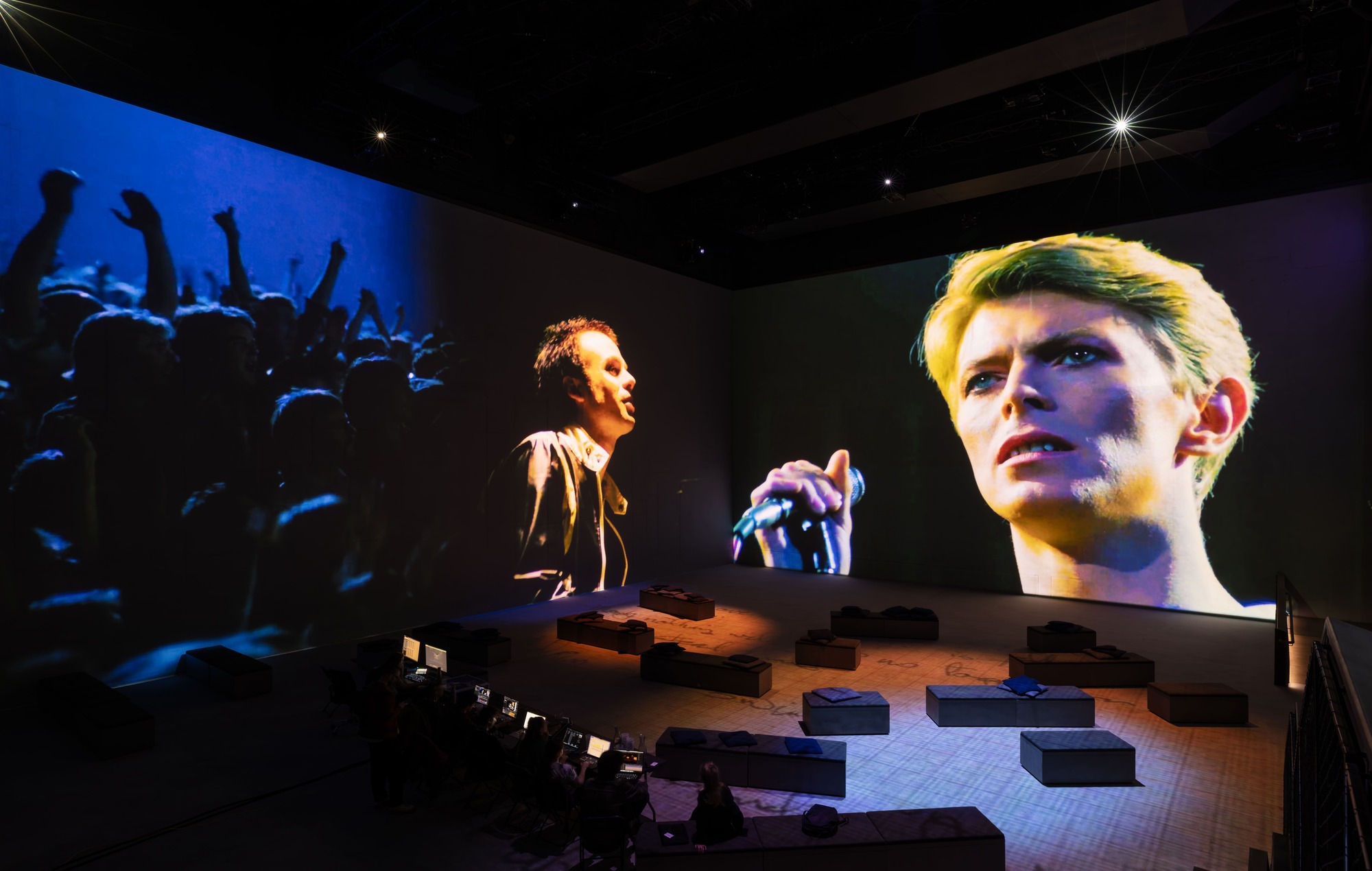
In London, the Bowie legacy is having a very public second life. Between the newly opened David Bowie Centre at the V&A East Storehouse and a steady stream of archive projects, the question is no longer whether there’s more to see—it’s how to present it without turning him into a museum statue.
That’s the challenge David Bowie: You’re Not Alone takes on at Lightroom, the King’s Cross venue known for large-scale projection shows. Ahead of its public opening, the production team walked through how they built the hour-long, looping 360° experience using material from the David Bowie Archive: films, photographs, handwritten notes, lyric sheets, drawings, and audio, much of it rarely shown.
The show was written and designed by Mark Grimmer of 59—also creative director of the V&A’s landmark David Bowie Is exhibition—alongside Tom Wexler. Structurally, it avoids a straight biographical timeline. Instead, it moves in thematic chapters, with Bowie narrating in his own voice, pulled from more than 500 hours of interviews.
Early on, Bowie recalls growing up in South London in bleak postwar suburbia, describing concrete, commuter routine, and a life that felt pre-written. That memory sets the tone for what follows: not a greatest-hits reel, but a portrait of an artist who kept building exits for himself, then inviting everyone else through.
The venue helps sell that idea. Lightroom’s 11-metre walls and floor become a wraparound canvas, and the spatial audio gives the concert sections real physical weight. Live footage is the obvious hook, but the deeper pull is in how it’s been treated: isolated camera angles, reconstructed rehearsal material, and recut archive sequences, including footage from D.A. Pennebaker’s Ziggy film presented in a new edit.
One standout sequence rebuilds a rehearsal performance of “Stay” into a full 1976-era concert environment, while other sections jump to the 1978 Earl’s Court period and Bowie’s less revisited ’90s output. There’s also a quietly emotional passage around his final live performance in 2004.
Speaking to NME, Lightroom executive producer David Sabel said the team aimed for emotional fidelity rather than literal reenactment: “This show covers a huge range of David’s life and career and his art, and is told entirely in his own words. We went through 500+ hours of interviews and stitched together a kind of narrative. It’s not a biopic, it’s not a chronological storytelling, it’s much more thematic.
“It has two modes: one is about his approach to his art and songwriting—which is more being inside his head as a creative and a person—then you have these major tentpole concert moments where you travel back to 1978 Earl’s Court or to the 1976 Isolar tour, which has never been seen before.”
Elsewhere, Sabel pointed to the scale of cooperation with Bowie’s estate and archive, and why Bowie in particular suits Lightroom’s format: “What’s great about Bowie is he’s a very unique musician in terms of his visual universe, in terms of all the set models, the theatricality and all the things we can bring to life in quite a unique way at Lightroom.
“There’s a performance of ‘Stay’ which was rehearsal footage that we’ve reconstructed as a concert environment from 1976, on all of the performances we’ve gone back to isolated cameras and angles that have never been seen. There’s even footage from the famous D. A. Pennebaker Ziggy film, but it’s been recut and reimagined in a way that’s completely new.”
The voice-led scripting also makes space for Bowie the person, not just Bowie the icon. In the interview material, he’s witty, occasionally blunt, and notably open about missteps. Sabel highlighted a section on Bowie’s 1972 Rainbow Theatre show, where Bowie admits it fell short of what he wanted—exactly the kind of self-assessment that keeps the production from slipping into tribute-night mythmaking.
“You get a sense of how funny he was, he’s very self-deprecating and down to earth,” Sabel said. “We often hold up Bowie as this genius and icon, and of course he was, but at the same time he was very, very human. There’s an intimacy in the narration through his words which lends a different portrait of who he was as a person and what preoccupied him.
“He talks a lot about wanting to make a mark and the search for one’s place in the universe. That’s where the title comes from: there’s a connection through art. In the concert footage you see fans throughout the decades. The fashions change, but you really can connect with that.
“There’s a sense of being at a gig, but you’re also time-travelling.”
David Bowie: You’re Not Alone runs at Lightroom from 22 April to 10 October. The venue is also hosting “Bowie Nights,” with appearances from Anna Calvi, Adam Buxton, and longtime Bowie guitarist Carlos Alomar. Later this year, Earl Slick reunites members of Bowie’s Glastonbury 2000 band for the charity event Bowie: Live On The Loch at Cameron House, Loch Lomond, on November 7 and 8.
