Physical Address
304 North Cardinal St.
Dorchester Center, MA 02124
Physical Address
304 North Cardinal St.
Dorchester Center, MA 02124
On May 9, 6ix9ine and Big Bank dug into a leaked 2015 Young Thug interrogation on Perspektives With Bank. Bank argued Thugger's words didn't lock people up; 6ix9ine countered, defending his 2019 cooperation and framing his online behavior as survival.
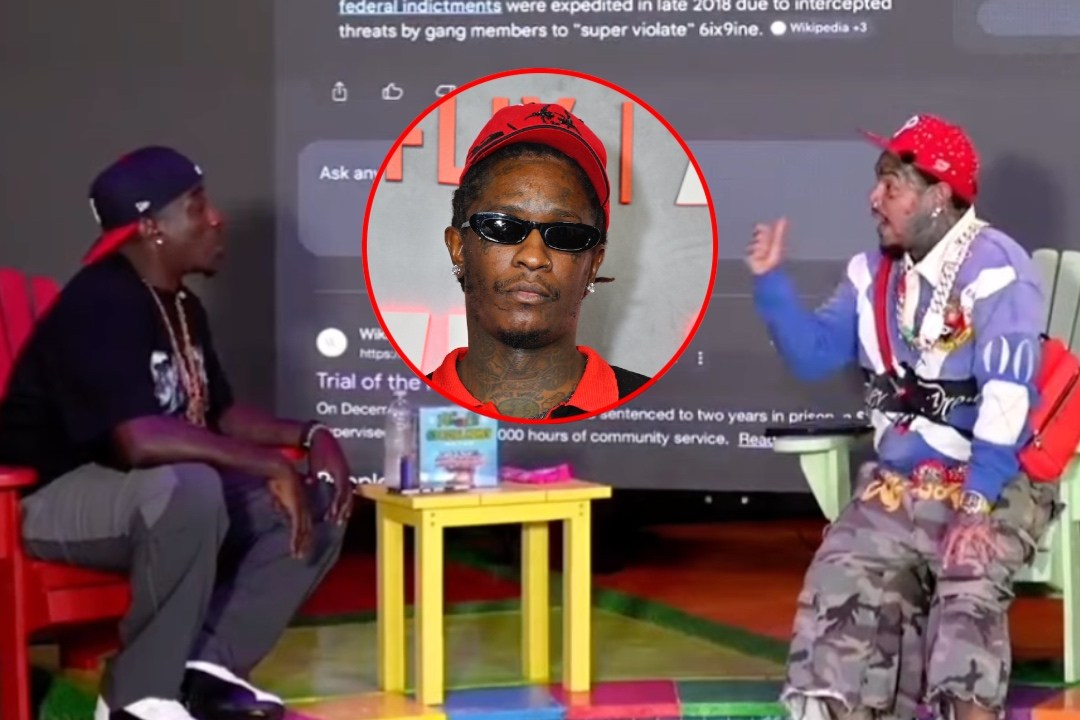
Talk about snitching rarely lands as neatly in a podcast studio as it did on May 9, when 6ix9ine sat across from Big Bank in the freshly renovated Perspektives With Bank streaming room and they spent a long, messy hour unpacking a leaked 2015 interrogation video of Young Thug. The conversation felt less like a sober legal parsing and more like two figures trading barbs while the internet watched the score settle in real time.
Bank opened the episode with a tone that was part defense attorney, part cultural chronicler. He argued that what viewers saw in the old interrogation clip wasn’t the kind of testimony that sent people to prison, and framed the backlash against Thugger as a different kind of fury entirely — a racialized resentment aimed at someone perceived to have cooperated with law enforcement.
Bank: I don’t think what Thug said locked people up. I think a lot of the heat for 6ix9ine came because the narrative was that he helped put Black men away — and that carries a different weight in the public imagination.
6ix9ine took that and leaned into it, offering the sort of blunt, performative logic that has defined his public life since the 2018–19 Nine Trey saga. He didn’t speak in hypotheticals. He went concrete and confrontational.
There are levels to ratting. So I told on some Brothers. Who killed Nipsey? A Brother. Who killed Von? A Brother. Who killed PnB Rock? A Brother?
There’s a choreography to how 6ix9ine frames these moments — part grievance, part provocation. He reminded the room of his 2019 federal cooperation against members of the Nine Trey Gangsta Bloods, evoking the kidnapping claim that has been central to his public account of why he flipped. It’s a familiar script for him: paint the cooperation as survival, then weaponize it into a cultural indictment.
Watching the episode, you can feel the push and pull between two lines of argument that have circulated in hip-hop for a decade. One holds that cooperating with police breaks a communal code with real-world consequences. The other — less triumphant, more legalistic — asks whether the thing that looks like “snitching” in a clip actually meets the threshold of testimony that materially harms other people.
Big Bank kept returning to that legalistic distinction. He was insistent that a viral clip alone doesn’t equal conviction, and that the leak itself deserved scrutiny. He also interrogated the politics underneath public outrage: why some forms of cooperation are met with condemnation while others become footnotes in larger criminal narratives.
6ix9ine’s answers were often transactional. He acknowledged that his online antagonism is precisely how he pays bills — an admission both candid and performative. The interview didn’t attempt to adjudicate truth so much as let personalities collide: Bank calibrating a measured, contextual stance; 6ix9ine preferring provocation and absolution in equal measure.
Elsewhere in the conversation, the two circled the broader cultural cost of the snitching label. For many fans and peers, the term is shorthand for betrayal, and Betrayal in this context is beholden to history — a history of surveillance, police violence, and communities that have often been punished for cooperating with the state or for being perceived to have done so.
Speaking to the camera, 6ix9ine repeatedly recast his cooperation as both necessary and unavoidable, a line he has trotted out since 2019 when he testified and ultimately received a reduced sentence. Bank pushed back less on the morality of that cooperation than on its consequences, focusing instead on the difference between incendiary headlines and prosecutable testimony.
There’s a meta angle worth noting: the very platform that amplified their debate — a glossy, renovated studio aimed at streaming sway — is also how these narratives metastasize. Clips from the episode have already circulated across social feeds, edited for outrage and clicks. The format makes nuance difficult to sustain; soundbites thrive.
After an hour, the conversation felt unresolved in a way that’s probably intentional. These debates rarely land on tidy verdicts; they settle instead into public opinion, into hashtags, into the next episode or the next clip. For 6ix9ine, playing the provocateur has been an economic strategy as much as an identity. For Bank, hosting the debate is part of a broader cultural project — testing limits and sparking conversation, however combustible.
Whether listeners come away convinced that Thugger didn’t snitch, or that 6ix9ine’s brand of contrition is a cynical survival tactic, depends on the listener’s frame. What the episode made clear is that the word “snitch” in hip-hop continues to function as a kind of linguistic shorthand for a dozen different anxieties: legal, racial, ethical, and economic. And in the current media environment, those anxieties are almost always lit by camera lights.
Clips from the interview have been shared widely online since the episode aired. For those following the long, contentious line from Nine Trey to leaked interrogation footage to today’s debates, the May 9 conversation read less like news than a live demonstration of how hip-hop’s ethics are argued in public.
6ix9ine, to Bank: I got kids. I got to feed my family. The internet is the way I do that. You can judge me, but that’s the reality.
The interview didn’t settle the question. But it did expose the seams of it: legal technicalities, personal histories, and a media ecosystem that prizes spectacle over slow scrutiny. That tension, fraught and unresolved, is exactly why people kept watching.