Physical Address
304 North Cardinal St.
Dorchester Center, MA 02124
Physical Address
304 North Cardinal St.
Dorchester Center, MA 02124
At the 52nd AMAs in Las Vegas, hip-hop took center stage: Cardi B collected three trophies, Kendrick Lamar added another win, Monaleo scored Breakthrough Hip-Hop Artist, and Black Eyed Peas took Best Throwback Song.
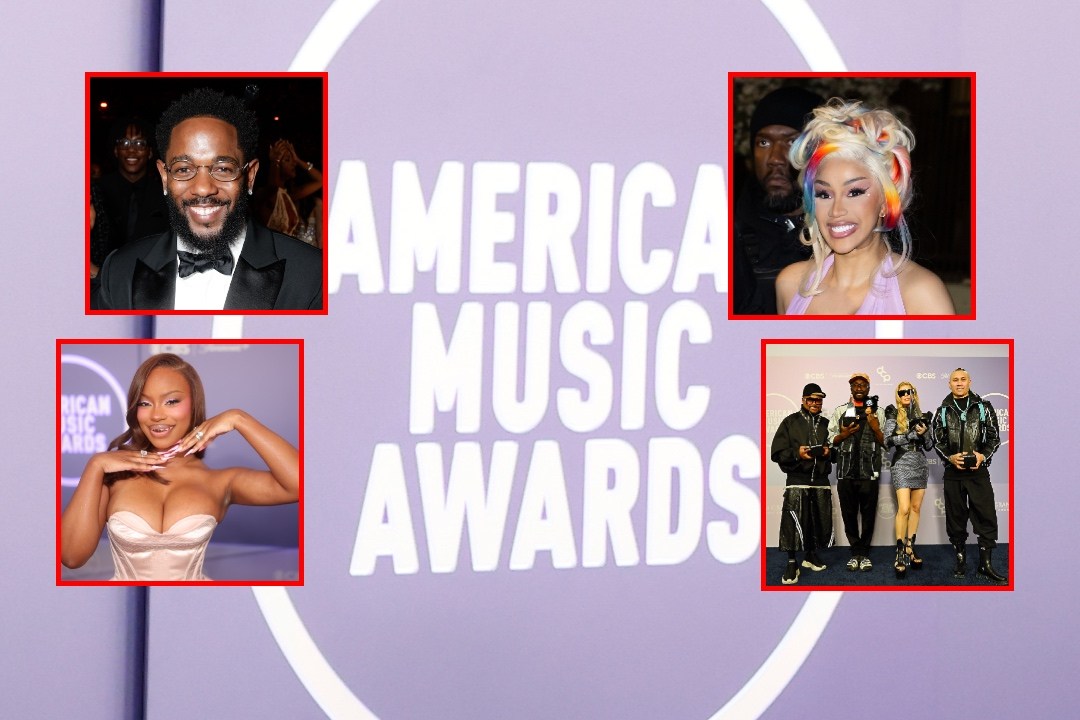
The American Music Awards in Las Vegas, this year short on surprises and long on hip-hop gestures, felt less like a strictly pop spectacle and more like a reckoning: a roomful of genre crossovers acknowledging that the year’s loudest stories came from the streets and the studio. On May 25, the MGM Grand Garden Arena hosted the 52nd AMAs, with Queen Latifah doing the honors as host — calm, wry, and easy at the podium — while awards kept tumbling toward rap acts in categories that once felt an afterthought on this stage.
Cardi B emerged as the night’s statistical focal point, collecting three trophies — Best Female Hip-Hop Artist, Best Hip-Hop Song for “ErrTime” and Best Hip-Hop Album for Am I the Drama? — bringing her career AMA total to nine. There’s a bluntness to Cardi’s presence that the cameras love: she moves like someone who knows how to make an angle go viral and how to flip poetry into headline lines. Her acceptance speeches were equal parts gratitude and shorthand for her origin story, delivered with practiced, immediate charisma.
“I been grinding since before this was fun,” Cardi said backstage, talking to reporters after accepting the album award. “It’s not just about trophies. It’s about doors, and I want to open them for the people that look like me.”
That line felt like the thesis of the night. Elsewhere Kendrick Lamar took home Best Male Hip-Hop Artist, edging out Don Toliver, Playboi Carti, Tyler, The Creator and YoungBoy Never Broke Again. It was another notch in a career-long arc that has moved from underground prophet to mainstream ledger—this marks his sixth AMA. Kendrick didn’t linger with a self-congratulatory monologue; instead, his win read like another stop on a deliberate map he’s been drawing for years: intense, exacting, slightly out of step with award-show performativity.
Monaleo’s Breakthrough Hip-Hop Artist (New) win was one of the night’s genuine small-victories moment. She stepped onstage with a kind of flinty, live-wire composure that makes her recent surge feel earned rather than manufactured. There was no grand production, just a young artist who has been building a fanbase with singles and virality, now vindicated by the industry’s ritualized nod.
And then there was the Black Eyed Peas, whose “Rock That Body” claimed Best Throwback Song (New), a category that somehow manages to be both nostalgic and oddly modern. Watching apl.de.ap and will.i.am accept the award, there was a reminder that pop-rap cycles back on itself: a party record becomes a cultural reference point, which gets re-digested by a new generation. Their win illuminated how the AMAs still treat catalog as an asset you can monetize in cultural memory.
Taylor Swift walked into the night with eight nominations and walked out empty-handed, which felt like one of the more quiet storylines — not a snub so much as a symptom of how the year’s music economy kept turning toward hip-hop categories when it came time to hand out trophies. Cardi tied with BTS, Sabrina Carpenter, Sombr, Bruno Mars and KATSEYE for the most wins of the evening; a scattershot group that underscores how awards, in 2026, are less about a single dominant narrative and more about multiple fan machines running in parallel.
Cardi’s momentum isn’t new. The Atlanta-to-international arc of her 2026 has already been catalogued: in February she picked up Outstanding Female Artist and Outstanding Album for Am I the Drama? Having nine AMAs now on her mantle is both a metric and a punctuation: she’s moved beyond the surprise of early career wins into the expectations of established success.
Speaking to several artists after the show, one recurring theme was visibility. For Kendrick, who’s spent years balancing critical acclaim with mainstream recognition, the AMA felt like part ceremony, part marketplace acknowledgment. For Monaleo, it was a door slamming open. For Cardi, a public tally of a sustained, high-volume year. And for legacy acts like Black Eyed Peas, it was an admission that throwbacks have value in the streaming era, where younger listeners discover past singles through algorithmic loops and chore challenges.
In a way, the 52nd AMAs read like a snapshot of hip-hop’s ecosystem in 2026: commercial reach, hereditary influence, breakout energy, and the commodification of memory. The stage lighting and camera cuts were smooth, the crowd polite and loud at the right moments, and Queen Latifah’s hosting kept the night from feeling stretched. But it’s the wins themselves — Cardi’s trio, Kendrick’s steady accumulation, Monaleo’s new entry, Black Eyed Peas’ retro victory — that will likely outlast the televised glitz.
It’s tempting to reduce award shows to ratings and red carpet looks. Last night, however, the AMAs felt more like a line drawn in the sand: hip-hop not only participated in the mainstream conversation, it largely steered it, even in a room designed to flatter a broad pop spectrum. That’s the year’s story, for better and worse, and these trophies are the footnotes.