Physical Address
304 North Cardinal St.
Dorchester Center, MA 02124
Physical Address
304 North Cardinal St.
Dorchester Center, MA 02124
Cities have begun to codify hip-hop into the urban map: Run-DMC’s Hollis corner, Biggie’s Fulton Street co-naming, and Tupac Shakur Way in Oakland. These street signs are civic gestures, delays of recognition, and a new way to anchor memory to place.
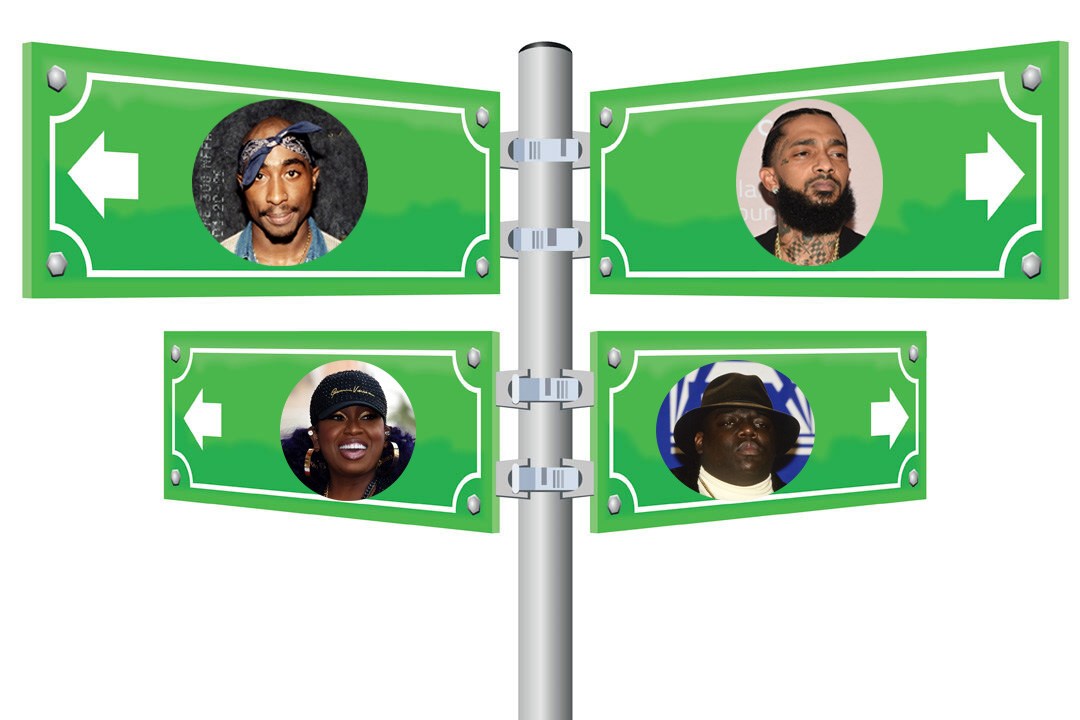
The ritual of naming a street after someone used to belong to generals, senators and musicians of earlier generations. Over the last 15 years, hip-hop has quietly taken its place in that municipal pantheon: fire hydrants and lamp posts dressed with small, blue signs that do more than point the way — they argue that these artists belong in the civic archive.
It began, for many people, in Hollis. In 2009 the corner of 205th Street and Hollis Avenue in Queens was renamed Run-DMC JMJ Way, honoring Jam Master Jay at the nexus of the crew’s childhood neighborhood. The ceremony felt inevitable; the group’s blocky Adidas silhouette had long been part of the borough’s visual DNA. But a street sign changes the conversation — it fixes a name to place, and by doing so it invites the city to remember.
Brooklyn’s answer came later. In 2019 the corner of Fulton Street and St. James Place was officially co-named Christopher Wallace Way. Christopher “Notorious B.I.G.” Wallace’s memorial sign sits where the city and the myth meet: a practical gesture that reads, for many fans, like restitution. The renamings have multiplied — sometimes fast, sometimes decades after an artist’s death — and in 2023 Oakland added Tupac Shakur Way, a sign planted 27 years after Tupac’s killing, a public punctuation to an unresolved cultural grief.
“It’s a moment that I know my brother would be proud of,” Sekyiwa “Set” Shakur said at the November 2023 dedication in Oakland. “Establishing love and peace in the Oakland community especially mattered to him. Being able to represent safety to his people mattered to him…Let his spirit live on the rest of these years in these streets and in your hearts.”
These street dedications rarely happen by accident. A lot of them trace back to persistent civic work — petitioning community boards, lobbying city councils, corralling family members and fans. One of the more visible organizers is LeRoy McCarthy and his outfit HeteroDoxX Inc., which has been pushing for co-namings and dedications since the early 2010s. McCarthy’s campaign started with an early 2013 effort to co-name St. James Place and Fulton Street for Biggie; that initial push didn’t immediately succeed, but it set a template.
“It’s a great look in America for hip-hop art and culture to have the same respect as other American music creations: blues, country, jazz, rock & roll, etc. have received over the decades, including a Hip Hop Resolution in the U.S. Senate,” McCarthy told XXL. “I am proud that my company HeteroDoxX Inc. initiated for this momentum to happen, in NYC, at Capitol Hill, and across America, starting in 2013 with Christopher ‘Notorious B.I.G.’ Wallace Way in Brooklyn, NY, through to the 2023 dedication of Tupac Shakur Way in Oakland, CA; and congratulations to all of the other hip-hip street signs because hip-hop is from the streets, but it’s not over because: Hip Hop Don’t Stop.”
Elsewhere, cities have used these co-namings to draw tourist routes and to stitch local histories into a wider narrative. New York, Los Angeles, Oakland, and other municipalities have recognized not just solo stars but crews and scenes: Wu-Tang Clan members, Phife Dawg, and posthumous tributes to artists like Nipsey Hussle have received similar civic nods. The gestures run the gamut — from small plaques tucked into commercial corridors to full ceremonial signs at high-traffic intersections.
There’s a tension baked into the practice. A street sign is both a final honor and an oddly bureaucratic one: it’s a local ordinance plus a memorial. Sometimes the most meaningful moments come from the margins — a block party on a renamed corner, a plaque that draws schoolkids to learn a history they never had in textbooks. Other times the signs reveal how long recognition can take; Tupac’s Oakland dedication, coming nearly three decades after his death, felt less like instant canonization and more like a delayed, necessary civic correction.
For the artists and families involved, the naming is rarely about stardom alone. It is about place-making and memory, about making a geographic claim that ties an artist’s cultural output back to a community. And for fans it works as a living map of influence: follow these corners and you trace a timeline of the music itself.
There are more to come. Cities keep listening — and voting — and the list of streets that carry the names of rappers will likely grow. For now, the signs are small, stubborn monuments: imperfect, municipal, and somehow essential.